PATRICK HASSON
The creator of the fascinating and magical world of Rainbowland 🌈✨

Patrick Hasson is the creator of the magical and fascinating world of Rainbowland as well as an award-winning Joshua Tree artist celebrated for his bold imagination, unmistakable "Rainbow Pop" style, and vibrant use of color. A former independent filmmaker, he reinvented himself as a painter, developing a signature dripping technique that creates richly textured works full of movement, emotion, and life. His acclaimed series, including Desert Dudes and 1969, have earned widespread recognition, with his artwork featured by HGTV, USA TODAY, VICE, and Palm Springs Life, and collected throughout the United States and Europe.
Beyond his remarkable talent, Patrick is known for his sweetheart, engaging personality, and genuinely caring spirit, qualities that shine through both his art and the welcoming creative community he has built at Rainbowland Studio and the world-famous Rainbow House. He continues to inspire audiences with artwork that is joyful, fearless, and uniquely his own.

THE INTERVIEW
1 - Dezert Light: What is Rainbowland?
Patrick Hasson: Rainbowland is a roadside attraction, art studio, art gallery, art park, film/photo locale, event space, and one-day art retreat, where art of all kinds will be created and enjoyed!
2 - Dezert Light: Where were you born, and what are some of your earliest memories of growing up there?
Patrick Hasson: I was born in Lebanon, Pennsylvania, and then lived in Trenton, New Jersey until I was eight, and then right outside Northeast Philadelphia until I flew the coop at 17. My childhood was pretty oppressive and had absolutely zero support for any creativity that existed inside of me, so I’ve blocked most of it out. My fondest memory of the Philadelphia/Trenton area was leaving it for Florida.
3 - Dezert Light: What’s your zodiac sign
Patrick Hasson: Scorpio:)
4 - Dezert Light: Before becoming a painter, you spent two decades as an independent filmmaker. What originally drew you to storytelling through film?
Patrick Hasson: After living in Florida for a couple of years, I enrolled in the Fine Arts College at the University of South Florida in Tampa. I had zero confidence in my creative skills, and while taking a Drawing 101 class, my instructor told me in no uncertain terms that I was a bad drawer and that perhaps a career as an artist wasn’t in the cards for me. Because I never had any sort of mentor or creative support, I was really affected by this. The following semester I discovered that the college offered some experimental cinematography classes, so I enrolled. Always a fan of films, I absolutely loved the concept of creating art on celluloid, and I didn’t need to be a good drawer to do so:) I was introduced to the films of Kenneth Anger, Stan Brakhage, Maya Deren, and so many others. I created several experimental short films on 16mm film during my time there, learning the art of directing and editing by just going out and doing it. Once I graduated, I really wanted to learn the art of narrative storytelling, so I wrote an experimental feature film entitled THE SPEED OF MIND. I wanted to challenge myself and see if I could write, direct, edit, and produce a feature film on my own. As I was still learning the art of screenwriting, the story was a bit weak, but the visuals were extremely unconventional, and the film got some attention on the festival circuit. I proved to myself that I could be a feature writer/director, but I really needed to work on my skill as a writer.
For my next film, I wanted to do a dark comedy about the restaurant business (as I worked in it all through college and after), so I took extensive notes and made character sketches each night while working as a waiter at an Italian restaurant in Tampa. Over the course of a year, I wrote a screenplay entitled WAITING. I had met a producer in New York City while living there for six months, and he really dug the story and wanted to produce it. Turns out, he was from Philadelphia, so I moved back to Philly, and we started raising money to make the film. Within a year, we raised $25,000 and got a few name actors (Will Keenan, Kerri Kenney, Lloyd Kaufman) on board, shooting the film in Philadelphia over the course of a month. Clearly, I had a knack for comedy as the film was a big hit on the festival circuit and won numerous awards, but as a storyteller, I felt I had taken a large step forward and was gaining confidence in my talents.
I knew the next step for me was moving to Los Angeles and taking a shot at becoming a serious writer/director, so I wrote a Hitchcockian dark comedy (DEAD BROKE) about a broke guy living in a large communal house who becomes so desperate, he starts eating the cat food of the two cats who also live in the house…then the cats take vengeance on him. I wanted to use it as a calling card to get representation, so I really took my time storyboarding every shot in the film. I shot the film by myself over 13 days with hundreds of setups, but little did I know that this would be the last time I had total control of a project (which in hindsight was a great learning lesson). I moved out to Los Angeles in April of 2002, not knowing anyone and having zero clue about how Hollywood worked…I was in for a rude awakening. DEAD BROKE was well received, and I was invited to numerous film festivals, including the Berlin Talent Campus at the Berlin Film Festival, but I was discovering that getting work and trying to pitch new projects was extremely difficult without connections to the gatekeepers of Hollywood, especially when I was trying to pitch dark original comedies that weren’t based on IPs or comic book heroes.
Over the next few years, I wrote and directed two feature documentaries based on the various occupations I would find myself in trying to squeak out a living in Los Angeles. The first was MR. PATRICK & THE HOLLYWOOD STARS, a film based on the filmmaking workshops I used to teach to underprivileged middle school students throughout Los Angeles through a non-profit called L.A.C.E.R. We shot the film over a school semester, and the film ended with a Hollywood premiere of the students’ film at the Egyptian Theater in Hollywood. We shot a really amazing film, but the reality was we needed about $50,000 to hire a full-time editor to put the documentary together. I was barely making enough money to pay my bills working for L.A.C.E.R., but I managed to cut together a 10-minute work-in-progress trailer of the film in order to raise money. Unfortunately, after several years of trying, I was never able to pull it off. The same happened with the HOW I BECAME A PORN DIRECTOR documentary. Working in the porn industry (as a video editor) for several years following my departure from L.A.C.E.R., I wrote and directed the film over the course of a year and cut together a 10-minute work-in-progress trailer to raise money to edit the feature. The trailer suddenly became one of the hottest projects in Hollywood as various parties wanted to raise millions to get the film completed (even though we only needed 50K for the edit). I had meetings all over town for the next couple of years, but just like the first project, I wasn’t able to raise the money to complete the film, and the project lost steam.
It was during this time that I broke off my engagement to my long-time girlfriend, and I found myself living in a storage shed because I didn’t want to bug friends about crashing on their couch. Little did I know that my next screenplay would be based on this experience, especially after discovering there were other people living in the storage shed complex (which was extremely creepy hearing them moving down hallways late at night). After four months of living there, I finally got back on my feet and moved into an apartment and cranked out a horror script called BLOOD SHED. For the next three years, I pitched it around town, and sometime in 2012 a producer came on board and raised 2 million dollars for the budget, and I was green-lit to direct. For the first time since arriving in Hollywood, I felt that I had finally ‘arrived.’ My project was funded, and we shot the film over a month in a storage shed complex in Mission Hills. We shot a really creepy film that, if edited correctly, could be a real hit. Unfortunately, the producer took it over in the editing room, and instead of slowly building the story, he went for the cheap, big scares and ruined it. The film was so bad I walked out of the editing studio and considered taking my name off the project. On the night of the film’s premiere, instead of attending, I checked into a 30-day-rehab because my alcoholism and drug addiction had become so bad, I just couldn’t do it anymore. 12 years of trying to create art on film destroyed me. I loved the art of storytelling, but hated the restrictions of trying to do it in Hollywood. There had to be another way of creating art.
5 - Dezert Light: What inspired you to leave Los Angeles and build a new life in Joshua Tree? Was there a defining moment when you knew the desert was home?
Patrick Hasson: Well, carrying over from the last question, by the time I walked out of rehab in April of 2014, there was one thing I knew for sure…I was no longer happy being a filmmaker in Hollywood. Yes, I loved films, and I loved creating, but I hated all the garbage that came along with raising money, navigating personalities on set, and then losing creative control of the project when it really mattered. It grew even more tiresome while watching trust-fund kids getting their parents to finance million-dollar-projects or seeing nepotism in full effect as the relatives of famous actors/filmmakers/studio heads got all the directing jobs because of whom they were related to. I’m not big on making excuses, but fuck, it was hard witnessing this each day. I didn’t want to do it anymore, and I was tired of struggling financially, knowing that I would never be able to afford even a tiny house in the worst part of South Central.
The one thing I had going for me at the time was that I was still employed as a full-time video editor at Playboy, so I had a record of steady employment. Another thing I had going was that I had been coming out to Joshua Tree for years after reading an LA Weekly article about Queens of the Stone Age and the whole Desert Rock scene (which totally blew me away…especially the DIY ethos of the place), so I was aware of what a magical place it was. Once I got out of rehab, I thought, “wonder what a house goes for out there?” I soon found out you could grab a fixer-upper in Joshua Tree for as low as $60,000, so with my steady work history, I was able to finance an old, beat-up drug house for $73,000. My friends in the film world thought I was crazy, asking, “ What are you going to do out there…smoke meth?”
I really wasn’t sure what I was going to do with the house, but I knew I at least had a place I could die in, which was strangely reassuring. I started staying out there on the weekends and discovered that tweakers would knock on my door at all hours of the night because they still thought they could score meth here. So the first order of business for my new house was painting its shit brown exterior a different color…something so different that EVERYONE would know it wasn’t the meth house anymore. I chose Summer Citrus Orange, an almost neon shade of orange paint (Behr Paint) from Home Depot. At this time (2014), Joshua Tree was basically two colors, brown and beige. Color, especially bright colors, was not part of the landscape as they are now, so my neon orange house immediately got lots of attention (a lot of it bad)...but the good news was, the tweakers stopped coming, so mission accomplished.
What really struck me was the transformational power of color, especially with a simple coat of paint. This brilliant shade of orange paint took my dingy, depressing, shit brown house and gave it new life. The orange exploded against the high desert sun and intensified everything around it. The sky was bluer, the Joshua trees were greener, and my little house suddenly seemed like a work of art against the desert landscape. It was in that moment that everything changed. I didn’t know it yet, but from that day forward, I would never be able to exist in a white or brown environment again.
Back inside the house, I stared at its dirty white walls. I felt like I wanted to scream; it all had to change. I thought back to the color wheel I learned in art school…you had your primaries - blue, yellow, red – and your secondaries - orange, green, and purple. I spent the next few weeks over at the Yucca Valley Home Depot, trying to find the most saturated shade of red, blue, purple, etc. I bought countless test samples and painted each on the walls of the various rooms. The kitchen became Citrus Splash Yellow, the living room Song Bird Blue, the living room Grenadine Red, the master bedroom Orchid Kiss Purple, the bathroom Limeade Green, and the other bedroom Summer Citrus Orange.
After months of driving out from LA on the weekends and painting non-stop, my ugly little meth house became a beautiful, rainbow-colored home that I couldn’t be more pleased. Only problem was, I was still living in LA and had no idea how I was going to make money if I stopped editing porn (which I had to, otherwise I’d be back to drink and drugs in no time). Maybe I could turn the house into a writer’s retreat? I knew lots of writers, but I didn’t know a lot who had the money to rent a retreat. Then, one day while talking to a friend, he pitched the idea of putting my house on Airbnb. Seemed like a possibility, but I needed to decorate the house as it was pretty barren with the exception of the colorful walls.
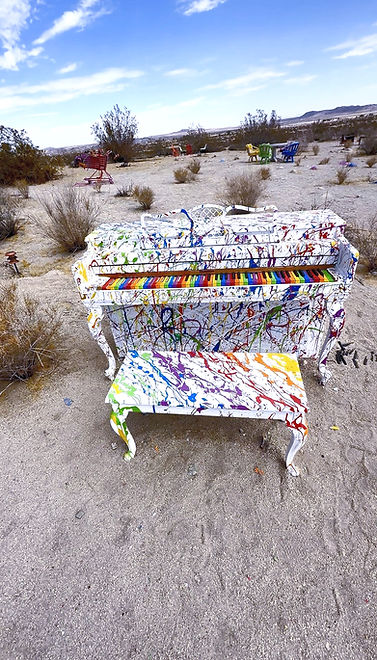
I started hitting the Olvera Street Market in Downtown LA, buying $10 mini guitars and inexpensive Mexican blankets for the house. I scoured the thrift stores in Joshua Tree and bought $20 tables and chairs (back when you could find them). With the leftover house paint, I splashed the six colors onto the guitars and tables, Jackson Pollock style. It was the first time I had attempted any sort of ‘art’ since my drawing professor eviscerated my confidence back in college. The effect was magical. Something about those six colors together triggered something in my brain. I wasn’t trying to chase the rainbow, but something way bigger than myself was in play, and for a few hundred dollars, I had furnished the house in a very unique way.
I called my Retreat RANCHO EL REPOSO, and soon after putting it on Airbnb, the reservations began coming in. I was shocked–having no idea if people would be interested in renting a house that looked like a set on Sesame Street–but they did. And the reservations grew. And the reviews were great. And suddenly I had an unexpected income stream coming in…not enough to pay all my bills, but enough to consider the idea of pursuing this further. I was coming up on a year of sobriety and my life, for the first time in a long time, seemed hopeful. And then I made the mistake of visiting a friend from rehab who had fallen off the wagon…
I stopped by his place in Azuza, and things were not well. He was smoking heroin and meth in 10-minute intervals and had clearly fallen from grace. I tried talking him into going to an AA meeting with me, but he had no interest. So, instead of leaving the apartment (as I should have), I noticed the small piles of pills on the glass table, including some which I had been horribly addicted to (Xanax and Percocet). For whatever reason, I thought to myself that I could have ONE Xanax…I had been doing so well the last year, and one pill wouldn’t do much. So against all good judgment, I took one xanax (and then many more). Three days later I would awake from a blackout in the middle of an AA meeting next to my sponsor, who was none too pleased with me. I soon discovered I had taken my one-year cake totally fucked up, and my entire home group knew of my relapse.
Why do I bring this up? Because I was so embarrassed that I drove out to my place in Joshua Tree trying to figure out what to do next. I had let all my friends in AA down. Should I just go back to drinking and drugging? Back to editing porn and trudging through Hollywood? Or, should I just kill myself? And there I sat on my couch, eyes closed and weeping, thinking back across the last year. I had done all 12 steps with my sponsor, attended meetings each day, made hundreds of amends to so many people, and was really starting to turn my life around…but I blew it. I relapsed. I was at my absolute lowest point…and then, the strangest thing happened. I encountered what they call a ‘spiritual awakening.’ There are really no words to describe it…All I can say is that my body was enveloped in a warm embrace, feeling something much greater than I taking over, extracting all the pain and sorrow of so many years.
Then, a voice spoke to me. A voice that told me everything was going to be alright. I was exactly where I was supposed to be, and the people who had hurt me growing up could no longer do so. I had never believed in the Catholic ‘God’ I was raised on, but this was something. God? Perhaps. A Higher Power? Most likely. The voice told me I was on the right path, and it was right there and then that I knew Joshua Tree was my home. Whatever this colorful path of paint was about, I would continue to explore it, and I would listen to that voice from here on out (and get back to meetings).


6 - Dezert Light: How has living in Joshua Tree changed your outlook on life, creativity, and happiness?
Patrick Hasson: Well, carrying on from the last question…after my ‘spiritual awakening’ in Joshua Tree, I knew for the first time that there was something else out there, something way bigger than me, and this really changed my perspective on everything. Instead of seeing what I could ‘take’ from life, which basically was my whole film career, I now wanted to see what I could ‘give’ to life. Less worry about success and money and all those things…instead following my instincts and that little voice in my head that had awakened. If the voice was telling me to paint my driveway a rainbow sunbeam, that’s what I would do (and not question & hyperanalyze it like I did most things).
As far as my physical health, once I bought my second property in 2016 (which later would become Rainbowland) and I moved out to Joshua Tree full time, my stress levels went down about 1000 percent. I now had time to do things. I didn’t have to deal with traffic, constant stimuli, and the financial grind that is trying to ‘make it’ in Los Angeles. Plus, the cost of living in the desert is about half of what it is in LA, so you have the ability to have so much more. There is no ‘Rainbow House’ if I were still living in LA, or ‘Rainbowland,’ or having my own painting studio, or having 3 acres of land to create on. It’s just a much healthier existence for me out here in the Mojave Desert. Do I have a Trader Joe’s 10 minutes from my house? No. But I have peace, and time, and space, and a rainbow colored house with 5 awesome cats living in it with me. What’s better than that?
7 - Dezert Light: Your signature "dripping" technique is unlike traditional painting. How did you discover this approach, and when did you realize it had become your artistic identity?
Patrick Hasoon: Once I had both my properties set up as Airbnbs so I could make a living out here, I needed a place to live, so I put a little 5th wheel trailer at the edge of my property and lived in there with my 2 cats. The inside of the trailer was pretty plain and had this ugly linoleum floor, which I hated. I had just finished creating Rancho De Colores (my second Airbnb), so I had lots of rainbow colored house paint lying around. I thought about turning the floor into art, but I didn’t want to splatter paint on it like I had been doing on the little guitars, so I got the idea to put each color of paint into a plastic ketchup bottle that I bought at Walmart. By doing that, I could glob little circles of paint onto the floor and make sort of a rainbow mosaic across it. As I was doing this, I got the idea to take a house nail and drag it through the different globs of paint. Because it was house paint, the colors didn’t mix together into mud…Instead, I was able to create various designs through the colored orbs. And that’s when I had a ‘light bulb’ moment. What if I painted a canvas with this technique?
I started off painting on regular canvases. Laying the canvas on the floor, I raised the canvas with two long 2x4s and got down on my knees, then started experimenting. I soon learned that the paint started to get too heavy for the canvas and it would bend (pooling all the paint into the middle of the canvas), so I then switched to painting on wood. I called the technique ‘dripping’ as it was somewhere in between Pollock’s action painting and Van Gogh’s impasto. I started using all kinds of sharp objects to manipulate the paint on the canvas (nails, forks, the back end of a paint brush, combs, etc) and was able to create all kinds of interesting designs and textures. It really was unlike any painting style I was aware of, so I ran with it. I would paint a few sections, let them dry overnight, and then paint layers of top of layers. It was almost like painting in 3D.
Looking back, it’s no surprise that I came up with such an abstract way of painting. I’ll never be the type of artist who can sketch out a perfect likeness of someone’s face with pencil and paper, and I’m very much in awe of those who can. I feel like my style is equal parts expressionism, pop, and outsider art with a heavy dose of psychedelia.
8 - Dezert Light: You describe your work as "Rainbow Pop." What does that term mean to you, and what inspired you to create your own artistic movement?
Patrick Hasson: I feel like my style is equal parts expressionism, pop, and outsider art with a heavy dose of psychedelia. Some people have labeled my art as just Pop Art, which I agree with, but it’s something more. Over the course of the last decade I’ve spent out here in the desert, I noticed that people around town started to recognize me (as I was usually covered in rainbow paint) and say “Hey…you’re the guy with the rainbow house, right?” I would agree, but at that point I hadn’t gone quite ‘full-rainbow’ with both houses. For whatever reason, white canvases really freaked me out…so I would always start a piece by painting the canvas black and then going at it with the six signature colors that I had used on both houses. I became more and more obsessed with all the combination possibilities on those 6 colors on a black canvas.
It wasn’t until the pandemic hit that I would truly go ‘full-rainbow’ on everything. It was a couple of weeks into the pandemic, and I was living at Rancho El Reposo full-time because after living in the trailer for 2 years, I couldn’t do it anymore, so I turned the trailer into an Airbnb (Color Trip Trailer) and moved into Rancho El Reposo. By this time, the exterior of the house had been exposed to six years of desert sun and needed a new coat of paint, so I decided to repaint the house to get my mind off the pandemic. But, just as I was trying to figure out what color to paint the exterior, that little voice in my head said: “go full rainbow.” Now, I could have ignored the voice, knowing how much work it would involve to paint one’s house ‘full rainbow,’ but that voice hadn’t steered me wrong in six years, so I said, “fuck it…full rainbow it is.” Then, for the next two years (had no idea it would take this long), I set out to create THE RAINBOW HOUSE. I painted the outside various colors of the rainbow. I turned the corrugated metal fences into dripping rainbow murals.
I turned the walkways into rainbow paths. I painted every wall (and ceiling) of the garage with a rainbow ribbon. I became rainbow obsessed…every single part of the house became rainbow. My addictive personality had totally locked in on painting as many rainbows in this house as possible. People around town called me the Rainbow Man anyway…why not embrace this moniker in every facet of my life?
So, of course, as this rainbow fixation was going on, it spilled over into my paintings. I was now obsessed with injecting as many rainbow forms and combinations into my paintings as possible. Hence, ‘Rainbow Pop’ was born. I really enjoy the challenge of seeing how far I can take this obsession and where it will lead.
9 - Dezert Light: Your paintings are filled with bold colors, movement, and texture. What emotions do you hope people experience when they encounter your work?
Patrick Hasson: I’ve always been intrigued by movement and energy. It was something you could see throughout my films. Never being a fan of static shots, I was always looking for ways to create a kinetic energy on film, which is much easier to do than on a two-dimensional painting. You have music and editing and lighting and so many other elements coming together in a film scene, but how do you create movement and energy in a 2D painting? Van Gogh was a master at it. I think that’s really what appealed to me about my dripping technique…there are endless ways of creating movement.
From the circular swirls I create on the faces of my portraits to the way colors jump off a black canvas. And because my paintings will have from 5 to 10 layers within it each, it’s almost like I’m painting in three dimensions. The layers and drips create shadows and light, furthering the feeling of ‘movement’ in each piece. Lately I’ve been expanding my color palette and types of paint I’ll use…I started including blacklight paint to get some of the neon shades I couldn’t find in house paint. I’ve also started playing around with sparkly paint to give certain pieces a shimmer that was impossible with acrylic house paint…all of this adding to the kinetic energy I’m always trying to impose on the canvas.
And the cool thing about the blacklight paint is that each painting transforms into a totally different piece once you shut off the lights and turn on a blacklight. It’s really fascinating and something I plan to explore more, especially in my desert landscapes. When it comes to painting a portrait of someone, I’ll do a lot of research on them. And in the case of painting musicians (which I love to do), I’ll listen to nothing but their music throughout the painting process…really trying to channel their essence even though I know very little about them on a personal level. I try to get their ‘energy’ onto the canvas…even sometimes going as far as saying a little prayer…asking them to help guide me and do their portrait justice. That’s one of the things I really enjoy about having Rainbowland open to the public. People get to see my paintings up close, taking in all the textures and layers and colors. Social media is great, but a photo of one of my paintings doesn’t do it justice. You really need to see my work in person to appreciate all that’s going on.

10 - Dezert Light: Your Desert Dudes series introduced many people to your art. Looking back, what did that collection represent in your personal journey?
Patrick Hasson: When I began the series in 2018, I started to feel that perhaps painting was something I’d like to take a real shot at. I had painted a few portraits at the Joshua Tree Music Festival, and I was pleased with the feedback I was getting, so I decided to challenge myself and do a portrait series. I’ve always been a massive music fan (and wanna-be rockstar), and because Desert Rock was really what originally brought me out to the desert, I thought about doing a series (DESERT DUDES) which would celebrate the forefathers of this genre, many of whom still lived out here in the Mojave. So, for the next year, I turned the garage at Rancho El Reposo into a painting studio and went at it. I painted Mario Lalli, Chris Goss, Nick Oliveri, Josh Homme, Brant Bjork, Jesika Van Rabbit, John Garcia, Dave Catching, and so many others.
Truth be told, I was planning on doing about 50 portraits because there were so many amazing musicians in this genre, but then I got a studio visit from Michael McCall, who at that time was the Curator of the Yucca Valley Visual & Performing Arts Center. He really dug what I was doing and said he wanted to give me a show in the Fall of 2019. Suddenly, I had a deadline, so the series ended up being about 25 portraits because I ran out of time. I was really excited about the show, but two things happened because of it that I was really not expecting. The first was getting a call from Brian Bluesky at the Desert Sun who I had sent a press release to (and not really expecting a reply from). He wanted to visit my studio and do an interview. Being a Desert Rock fan as well, he seemed to dig the series idea, but what he found even more interesting was that I lived in a rainbow-colored house and owned a second one right down the highway. The interview was great, and I was hoping it would result in a nice piece on the Desert Dudes show, but it turned into something much larger.
To my surprise, I ended up on the cover of the Desert Sun Life Section & the Desert Post Weekly. The piece was so well written (entitled ‘Coloring His World’) and introduced the Coachella Valley to me, my crazy rainbow houses, and my upcoming Desert Dudes show. The story got A LOT of attention…it was even picked up by The Desert Sun’s parent company, USA TODAY, and landed me on the cover of the Life Section. Suddenly, the reservations for my two airbnbs skyrocketed, and other news outlets were asking me for interviews. Mr. Bluesky had generously put me on the map as a Desert Artist, but the coolest part was yet to come. At the opening week of the show, the ‘Godfather’ of Desert Rock, Mario Lalli, came to the show with his lovely partner Roberta. I was so flattered that one of my musical heroes would take the time to come to my show. He was extremely complimentary of all the portraits, noting that he had played with each and every one of them. Now, this was as cool as it could get for me, but a few days later, Mario hit me up. He asked me what I was doing for the Closing Party of the Desert Dudes show, and I replied, “nothing.”
He then asked me if I would be down to have him, Gary Arce, Chris Goss, Dave Catching, Sean Wheeler, Gene Trautmann, Jesika Von Rabbit, Arthur Seay, and Hutch do an improv jam at my Closing Party. I was speechless…then managed to mumble out “sure.”
This was the absolute, most mind-blowing thing that had ever happened to me…to have eight of my Desert Rock heroes jamming at my show’s closing party while the Sound Master of the Universe, Hutch, would be manning the board. It doesn’t get any better than that. My desert experience had definitely come full circle, and for the first time in my life, I truly considered myself a real ‘artist.’
11 - Dezert Light: Finally, if you could leave the readers of Dezert Light with one message about courage, love, and living authentically, what would you want them to carry with them for the rest of their lives?
Patrick Hasson: If you find yourself stuck in this life, or perhaps not really happy with it, I recommend that you take some time by yourself. Shut off your phone, your computer, go somewhere quiet and just be. Then, think about some of the things you enjoy, no matter how big or small. Perhaps you enjoy gardening. Listening to music. The color blue. Whatever it is…write down 20 to 40 things that you enjoy. Once you have this list, think about how you could inject some of these things into your life. Or, perhaps, how you could pursue one of these interests full time. I think in this crazy, non-stop world we live in, people don’t take the time to think about the things they really enjoy without judgement. Even finding a way to turn one of those interests into a career, as crazy as it may sound. Life is short, and the world can be a brutal place. Why not try to enjoy yourself along the way?


